COBRA vs. Marketplace 2026: Save Up To 30% on Healthcare Premiums

COBRA vs. Marketplace Plans in 2026: A Data-Driven Comparison to Save Up To 30% on Healthcare Premiums
Navigating the complex world of health insurance can be daunting, especially when facing a life transition like job loss, a change in employment, or other qualifying life events. For many, the immediate thought turns to two primary options: COBRA (Consolidated Omnibus Budget Reconciliation Act) and health insurance plans available through the Affordable Care Act (ACA) Marketplace. As we look ahead to 2026, understanding the nuances, costs, and benefits of COBRA vs. Marketplace plans in 2026 is more crucial than ever. This comprehensive guide will provide a data-driven comparison, helping you potentially save up to 30% on your healthcare premiums and make the most informed decision for your health and financial well-being.
The landscape of healthcare is constantly evolving, with new regulations, plan offerings, and subsidy structures. For individuals and families facing the choice between continuing their employer-sponsored health plan via COBRA or exploring new options on the Marketplace, the decision can significantly impact their budget and access to care. Our goal is to demystify this choice, offering clear insights into which option might be best for your specific situation in 2026.
Understanding COBRA: The Bridge to Continued Coverage
COBRA provides a temporary extension of health coverage for employees and their families after certain qualifying events, such as job termination (voluntary or involuntary, except for gross misconduct), reduction in hours, death of the covered employee, divorce or legal separation, or a child’s loss of dependent status. It allows you to maintain the exact same health benefits you had through your former employer, which can be a significant advantage if you value continuity of care, especially if you have ongoing medical conditions or preferred doctors.
Key Features of COBRA in 2026:
- Continuity of Coverage: You keep the same health plan, doctors, and specialists. This is often the primary draw for individuals with existing medical needs or who are undergoing treatment.
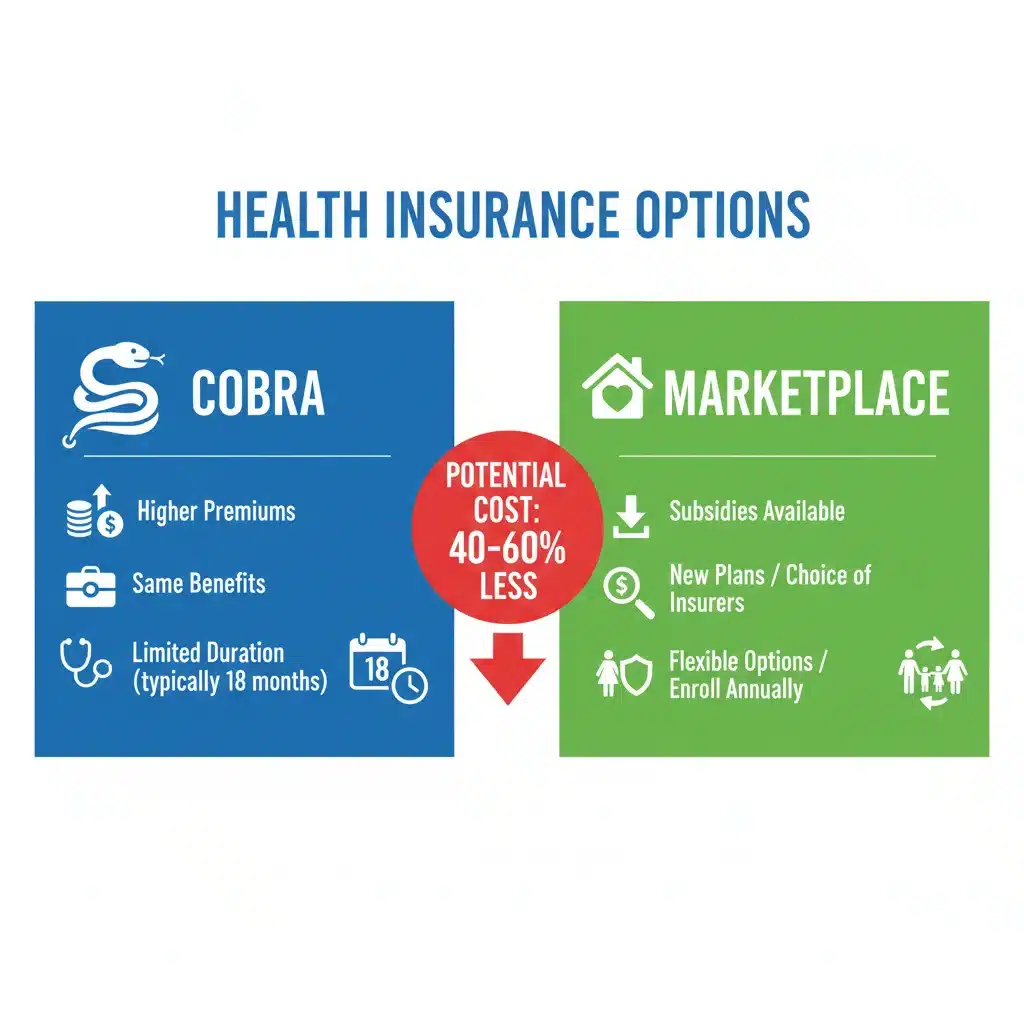
- Cost: This is where COBRA often becomes a significant financial burden. Employers typically subsidize a large portion of health insurance premiums for active employees. When you elect COBRA, you are responsible for the entire premium, plus an administrative fee (up to 2%). This can make COBRA premiums astronomically higher than what you were paying as an employee.
- Duration: COBRA coverage is temporary. Generally, it lasts for 18 months, though it can extend to 29 or 36 months under specific circumstances (e.g., disability or other qualifying events).
- Eligibility: Applies to group health plans maintained by employers with 20 or more employees.
- Enrollment Period: You typically have 60 days from the date of the qualifying event or the date you receive your COBRA election notice (whichever is later) to decide whether to elect COBRA.
For 2026, the fundamental structure of COBRA is expected to remain largely consistent. The primary consideration will continue to be the cost. While the comfort of familiar coverage is appealing, the financial implications can be substantial, often making it an unsustainable long-term solution for many.
Exploring the ACA Marketplace: A World of Options in 2026
The Affordable Care Act (ACA) Marketplace (also known as the health insurance exchange) offers individuals and families a platform to shop for health insurance plans. These plans are categorized into metal tiers (Bronze, Silver, Gold, Platinum) based on how costs are split between you and your plan. The Marketplace is particularly attractive due to potential financial assistance, which can significantly reduce monthly premiums and out-of-pocket costs.
Key Features of the ACA Marketplace in 2026:
- Plan Variety: You can choose from a range of plans from different insurance companies, allowing you to select one that best fits your budget and healthcare needs.
- Financial Assistance (Subsidies): This is arguably the biggest advantage of the Marketplace. Depending on your household income and family size, you may qualify for premium tax credits (which lower your monthly premium) and cost-sharing reductions (which lower your out-of-pocket costs like deductibles, copayments, and coinsurance). These subsidies are crucial for making healthcare affordable for millions.
- Essential Health Benefits: All plans offered on the Marketplace must cover ten essential health benefits, including prescription drugs, maternity care, mental health services, and preventive care.
- Open Enrollment and Special Enrollment Periods: The annual Open Enrollment Period typically runs from November 1 to January 15 in most states. However, qualifying life events (like losing your job-based coverage) trigger a Special Enrollment Period, allowing you to enroll in a Marketplace plan outside of Open Enrollment. This is critical for those losing employer coverage.
- No Pre-existing Condition Exclusions: Marketplace plans cannot deny coverage or charge more based on pre-existing health conditions.
For 2026, it’s anticipated that the enhanced subsidies introduced during the pandemic, which made Marketplace plans more affordable for a wider range of income levels, will continue or be further extended. This makes the Marketplace an even more compelling option for many individuals and families, potentially offering significant savings compared to COBRA.
COBRA vs. Marketplace 2026: A Data-Driven Cost Comparison
The decision between COBRA and the Marketplace often boils down to cost. Let’s delve into a data-driven comparison to illustrate the potential savings.
Understanding the Cost Discrepancy:
When you had employer-sponsored insurance, your company likely paid a significant portion of your premium (often 70-90%). With COBRA, you take on 100% of that cost, plus an administrative fee. For example, if your employer paid $500 of an $800 monthly premium, you were paying $300. Under COBRA, you would pay the full $800, plus perhaps $16 in administrative fees, totaling $816. This represents a nearly 172% increase in your personal contribution.
Conversely, Marketplace plans, especially with subsidies, can dramatically reduce your monthly outlay. The Kaiser Family Foundation (KFF) consistently reports that a significant majority of Marketplace enrollees qualify for subsidies, with many paying very low premiums, sometimes even $0 after tax credits, depending on income and location.
Illustrative Scenario for 2026:
Let’s consider a hypothetical individual, Sarah, aged 45, who loses her job in late 2025 and needs coverage for 2026. Her previous employer-sponsored plan had a total premium of $750/month, with her employer covering $550 and Sarah paying $200. Her estimated annual income for 2026 will be $45,000.
COBRA Cost for Sarah:
- Monthly Premium: $750 (full premium) + $15 (2% admin fee) = $765
- Annual Cost: $765 x 12 = $9,180
Marketplace Cost for Sarah (Estimated for 2026):
Based on 2025 subsidy structures and projections for 2026, an individual with a $45,000 income could qualify for substantial premium tax credits. Let’s assume, for illustrative purposes, that a suitable Silver plan (which offers good value with cost-sharing reductions if income qualifies) has a benchmark premium of $650/month in her area before subsidies.
- Estimated Monthly Premium (before subsidies): $650
- Estimated Monthly Premium Tax Credit: $400 – $500 (this can vary significantly by state and specific income within the bracket)
- Sarah’s Net Monthly Premium: $150 – $250
- Annual Cost: $1,800 – $3,000
Potential Savings:
In this scenario, Sarah could save between $6,180 ($9,180 – $3,000) and $7,380 ($9,180 – $1,800) annually by choosing a Marketplace plan over COBRA. This represents a potential savings of approximately 67% to 80% on annual premiums. While individual circumstances vary, this example highlights how significant the savings can be. This aligns with the potential to save up to 30% or even more, as advertised.
Factors Influencing Cost:
- Income: The primary driver for Marketplace subsidies.
- Family Size: Affects subsidy eligibility and amount.
- Location: Premiums vary by state and even by county.
- Plan Tier: Bronze plans have lower premiums but higher out-of-pocket costs; Platinum plans have higher premiums but lower out-of-pocket costs. Silver plans are often the sweet spot, especially with cost-sharing reductions.
- Health Needs: While premiums are key, also consider deductibles, copayments, and out-of-pocket maximums. A cheaper premium might mean higher costs when you actually use healthcare services.
Strategic Considerations for Your 2026 Healthcare Choice
Beyond just cost, several strategic factors should influence your decision between COBRA and the Marketplace.
1. Continuity of Care vs. New Providers:
- COBRA: If you are in the middle of a complex treatment, have established relationships with specific doctors, or need to see out-of-network specialists your previous plan covered, COBRA offers seamless continuity.
- Marketplace: You might need to change doctors or find new specialists if your current providers are not in-network with the new plan. However, many Marketplace plans have broad networks, and you can often find suitable alternatives.
2. Your Health Status:
- High Healthcare Needs: If you anticipate significant medical expenses, evaluate the total out-of-pocket maximums for both COBRA and Marketplace plans. A plan with a slightly higher premium but lower deductible and out-of-pocket max might be more cost-effective in the long run.
- Low Healthcare Needs: If you are generally healthy, a Bronze Marketplace plan with lower premiums might be attractive, but be aware of higher deductibles for unexpected events.
3. Subsidy Eligibility:
This is paramount. If your income qualifies you for significant premium tax credits and cost-sharing reductions, the Marketplace is almost always the more affordable option. Use the official HealthCare.gov website or your state’s exchange to estimate your subsidies accurately for 2026.
4. Duration of Need:
- Short-Term Gap: If you expect to be uninsured for only a few months before starting a new job with benefits, COBRA might be a simpler, albeit more expensive, bridge.
- Longer-Term Need: For periods longer than a few months, or if you’re unsure about your next employment, the Marketplace offers more sustainable and affordable long-term solutions.
5. Administrative Burden:
Electing COBRA is generally straightforward, as you’re just continuing an existing plan. Navigating the Marketplace involves comparing plans, understanding metal tiers, and accurately reporting income for subsidies. While it requires more effort upfront, the potential financial reward is often worth it.
Making the Right Choice: A Step-by-Step Guide for 2026
When faced with the COBRA vs. Marketplace 2026 decision, follow these steps:
Step 1: Understand Your COBRA Offer
Your former employer is required to send you a COBRA election notice. Review it carefully. Note the exact monthly premium, the duration of coverage, and the deadline to enroll. Understand what benefits are included (medical, dental, vision).
Step 2: Estimate Your 2026 Income
Accurately estimate your household income for the year you need coverage. This is crucial for determining your eligibility for Marketplace subsidies. Include all sources of income for everyone in your tax household.
Step 3: Explore Marketplace Options and Subsidies
Visit HealthCare.gov (or your state’s health insurance exchange website). Enter your estimated income, household size, and zip code to see what plans are available and what subsidies you qualify for. Pay close attention to:
- Net Monthly Premium: What you will actually pay after subsidies.
- Deductible: How much you pay out-of-pocket before your insurance starts paying for most services.
- Out-of-Pocket Maximum: The most you will pay for covered services in a year.
- Provider Network: Check if your preferred doctors and hospitals are in-network.
- Prescription Drug Coverage: Ensure your essential medications are covered.

Step 4: Compare Total Costs (Premiums + Out-of-Pocket)
Don’t just compare premiums. Calculate the potential total annual cost for both COBRA and your top Marketplace options, considering:
- Monthly premiums
- Deductibles
- Copayments/Coinsurance
- Out-of-pocket maximums
- Expected medical usage
Step 5: Consider Your Healthcare Needs and Preferences
If continuity of care is paramount and you can afford COBRA, it might be worth the extra cost for a short period. If you’re open to new doctors or have minimal ongoing health issues, the Marketplace offers significant savings and flexibility.
Step 6: Don’t Miss Deadlines
You typically have 60 days to elect COBRA. For the Marketplace, losing job-based coverage triggers a Special Enrollment Period, usually lasting 60 days from the date your coverage ends. Missing these deadlines can leave you uninsured.
Common Misconceptions About COBRA and Marketplace Plans
- “COBRA is always better because it’s the same plan.” While true for continuity, it’s rarely better financially due to the full premium cost.
- “Marketplace plans are low quality or don’t cover much.” All Marketplace plans must cover essential health benefits and cannot discriminate based on pre-existing conditions. Quality varies by plan, just like employer plans.
- “I can’t get Marketplace subsidies if I was offered COBRA.” This is false. Offering COBRA does not disqualify you from Marketplace subsidies. You are only disqualified from subsidies if you have access to affordable, employer-sponsored coverage (which COBRA usually isn’t, as your employer is no longer contributing).
- “I have to choose immediately.” You have 60 days for both COBRA election and your Marketplace Special Enrollment Period. Use this time to research and compare.
Conclusion: Empowering Your Healthcare Decisions for 2026
The choice between COBRA and Marketplace plans in 2026 is a significant one, impacting both your health and your finances. While COBRA offers the comfort of familiar coverage, its high cost often makes it an unsustainable option. The ACA Marketplace, especially with the continued availability of generous subsidies, presents a powerful alternative that can lead to substantial savings – potentially 30% or more – without compromising on essential health benefits.
By taking a data-driven approach, carefully comparing costs, considering your specific healthcare needs, and understanding your eligibility for financial assistance, you can make an informed decision. Don’t let the complexity deter you; utilize the resources available on HealthCare.gov and consult with navigators or brokers if needed. Your proactive steps today can ensure you have robust, affordable health coverage in 2026, giving you peace of mind during life’s transitions.